Why It Matters: Civic institutions often claim historical and climate preservation cannot coexist with all-electric requirements. This project demonstrates that combining deep ground-source heat exchangers, intelligent envelope engineering, and surface hydronic thermal dumps can eliminate fossil fuel reliance even in harsh winter climates without sacrificing strict museum-grade archival standards.
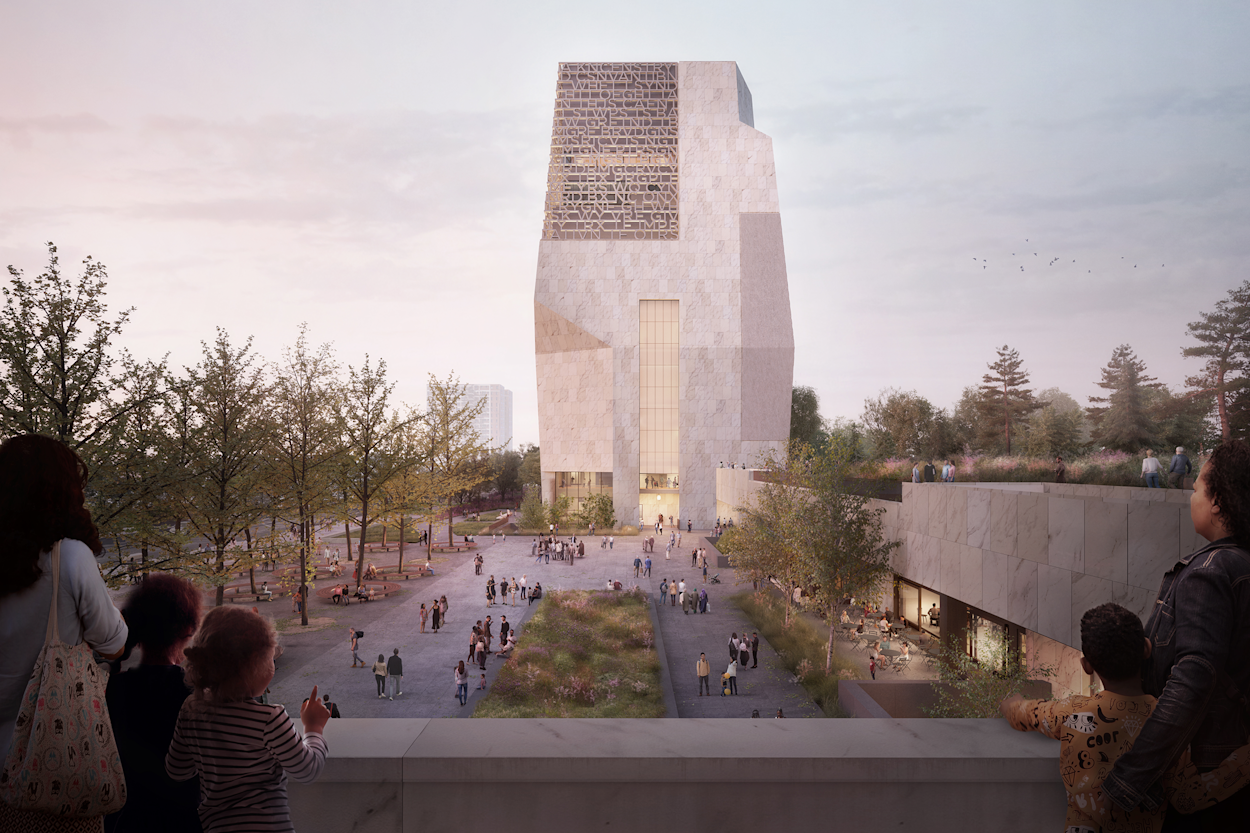
When the Obama Presidential Center opened its doors in Chicago on June 19, 2026, the 19.3-acre campus marked a decisive technical shift for major cultural institutions in severe cold-weather climates. Designed by Tod Williams Billie Tsien Architects | Partners with Interactive Design Architects, the project encompasses roughly 276,000 gross square feet of above-ground facilities and extends to 500,000 square feet including subterranean logistics and parking. Throughout the entire complex, day-to-day operations run entirely without on-site fossil fuel combustion.
Achieving total operational electrification in a Chicago winter presents steep engineering challenges, particularly for cultural facilities with strict indoor humidity and temperature thresholds for artifact preservation. The project team, steered by environmental design consultant Atelier Ten and MEP engineer of record Altieri, met these demands by embedding a campus-scale ground-source heat pump network, tight architectural envelope detailing, and an integrated stormwater infrastructure within historic Jackson Park.
Balancing Subsurface Loads in a Cold Climate
The core of the thermal strategy is a vertical ground heat exchanger engineered by GEOptimize Inc. The geothermal field consists of 160 vertical boreholes drilled 500 feet into the ground. These boreholes supply heat pump chillers that serve both radiant surfaces and forced-air distribution systems across the museum tower, the forum, the library, and underground facilities.
In northern climates, geothermal borefields often face long-term efficiency degradation caused by thermal imbalance. When a building extracts far more heat during extended freezing winters than it rejects during humid summers, the surrounding subsurface ground temperatures gradually drop over years of operation. To counter this, the engineering team introduced a thermal balancing mechanism that integrates an 800-square-foot hydronic snowmelt system at primary building entrances and circulation pathways. By selectively transferring excess thermal energy during transitional conditions, the system actively prevents ground freezing while maintaining public accessibility without chemical deicers.
Envelopes Engineered for Conservation and Wildlife
Museum towers are notoriously energy-intensive due to the need to isolate sensitive collections from exterior weather fluctuations. Atelier Ten directed extensive thermal bridge analysis, daylight penetration studies, and solar radiation modeling to refine the stone and glass enclosure of the main museum structure.
The facade balances interior daylight with artifact protection by incorporating high-performance glazing assemblies, custom ceramic frit patterns, and heavy structural thermal breaks. The frit patterns serve a dual operational role: they reduce peak solar heat gain, which lowers summer cooling loads on the ground loop, and mitigate bird collisions along the critical Lake Michigan migratory flyway. Over two acres of accessible green roofs cover the partially submerged Forum and Library volumes, providing substantial passive thermal insulation while physically linking pedestrian pathways to the surrounding parkland.
Closed-Loop Water Management and SITES Targets
Beyond its heating and cooling systems, the campus acts as a sponge within an urban watershed historically prone to flooding. Landscape architect Michael Van Valkenburgh Associates restored native and climate-resilient plantings across 30 percent of the site, establishing root networks that absorb heavy rainfall events.
The engineering team designed a site-wide stormwater retention system capable of capturing 98 percent of precipitation that falls on the property. This diverted water is directed through bioswales, filtration systems, and the park lagoon, virtually eliminating campus runoff into Chicago combined municipal sewer system. On-site retention also feeds local irrigation demands and graywater fixtures, reducing municipal potable water consumption by 89 percent compared to baseline institutional standards.
Pathways to Net Zero Energy Operations
The campus is actively targeting LEED v4 Platinum, SITES Silver, WELL Health-Safety, and the International Living Future Institute Zero Energy certification. While on-site rooftop solar photovoltaic arrays are installed on the Home Court and Garden Pavilion structures, the dense spatial requirements of the conditioned museum require supplemental off-site clean electricity procurement to cover total energy usage and achieve verified net-zero energy status under ILFI criteria.
As municipal energy codes across North America progressively restrict fossil fuel hookups in commercial and institutional construction, the Obama Presidential Center provides a real-world case study. It establishes that large civic anchors can preserve historic landscapes, protect fragile archival assets, and eliminate operational combustion simultaneously.
What Professionals Should Know
- Ground heat exchangers paired with hydronic snowmelt circuits solve subsurface thermal drift in cold climates by rejecting balanced heat loads.
- Integrated green roofs and native landscaping retain 98 percent of on-site precipitation, reducing municipal water demands by 89 percent.
- Eliminating fossil fuels in museum environments requires aggressive thermal break details and fritted daylight controls to safeguard collections.
Sources
- The Obama Presidential Center Opens in Chicago — Atelier Ten
- Obama Presidential Center’s Sustainability Approach — Atelier Ten
- The Obama Presidential Center's Commitment to Environmental Sustainability — The Barack Obama Foundation
- Sustainability at the Obama Presidential Center — The Barack Obama Foundation
- The Obama Presidential Center — Tod Williams Billie Tsien Architects | Partners
- The Obama Presidential Center — Altieri (Altieri Sebor Wieber LLC)
- Obama Presidential Center Ground Heat Exchanger Design & Modeling — GEOptimize Inc.
- Obama Presidential Center Jackson Park Landscape — Michael Van Valkenburgh Associates Inc
- Obama Presidential Center built for sustainability and climate resilience, and will help community too — CBS Chicago
- Chicago’s Obama Presidential Center Pursues SITES & LEED — American Society of Landscape Architects (ASLA)