Why it matters: For years, circular construction faced an administrative paradox: salvaged components offer immediate embodied carbon reductions, but Buy Clean mandates disqualified them because nobody issued environmental product declarations for reused goods. Standardizing how salvage enters product category rules gives suppliers the technical baseline needed to compete on institutional projects, turning circular rhetoric into legally compliant specifications.
Across the building sector, reclaimed structural steel, timber, and brick offer an immediate way to cut upfront embodied carbon. By avoiding raw resource extraction and primary smelting or kiln firing, salvaged materials circumvent the most energy intensive stages of production. Yet circular construction has run headlong into an administrative roadblock. Institutional clients, municipal reach codes, and public Buy Clean programs increasingly require third-party verified Type III Environmental Product Declarations, known as EPDs, before products can be specified. As of early 2026, zero certified EPDs existed in North America for reused construction products, according to the Carbon Leadership Forum.
The Administrative Paradox of Circular Building
This gap created a frustrating paradox for structural engineers, architects, and procurement teams. EPDs are generated according to strict Product Category Rules, or PCRs, governed by international standards like ISO 14025 and ISO 21930. Historically, every major construction PCR in North America was drafted entirely around virgin extraction and primary manufacturing. They mandate reporting on modules A1 through A3, measuring raw resource harvesting, transit to the mill, and factory fabrication. Because salvaged goods bypass primary manufacturing, program operators lacked the standardized accounting rules required to verify them.
As public agencies adopt Buy Clean requirements that mandate EPD reporting, circular components have found themselves technically disqualified. A salvaged timber beam or recertified steel wide flange might carry a fraction of the carbon footprint of its newly rolled equivalent, but without a recognized EPD format, public specifiers could not legally accept it under low carbon procurement rules. Instead, public investments continued to flow toward newly manufactured materials with certified paperwork.
Setting New Boundaries for Salvaged Inventory
To resolve this systemic barrier, the Carbon Leadership Forum published Reclaimed and Reused: Recommended LCA Modeling Guidance to Support EPDs for Reused Construction Materials. Authored by Brook Waldman, the research guide delivers standardized life cycle assessment conventions and boundary definitions designed to fit inside existing EPD verification ecosystems.
The cornerstone of the guidance is the burden-free cut-off approach at the point of salvage, aligning North American practice with ISO 21930, EN 15804, and EN 15978. Under this method, the environmental footprint of the donor building and its initial demolition are assigned to the original structure’s life cycle. The reclaimed material enters its second life cycle clean of historical burdens, but it must strictly account for every operational input required to prepare it for reinstall.
The CLF framework repurposes the standard cradle-to-gate modules A1 through A3 to fit circular supply chains. Module A1 captures the direct energy, fuel, and labor involved in selectively deconstructing and salvaging the product from the donor site. Module A2 accounts for logistics, hauling the salvaged component from the demolition site to a processing yard, warehouse, or remanufacturing facility. Module A3 covers all subsequent refurbishment operations, including cleaning, denailing, structural testing, remilling, shot blasting, and quality recertification.
Testing the Methodology Across Lumber, Steel, and Brick
To prove the framework’s viability, the study modeled pilot life cycle datasets across three high-volume circular materials: reclaimed dimensional framing lumber, structural steel sections, and salvaged clay brick. Each pilot examined the operational realities of collection and preparation.
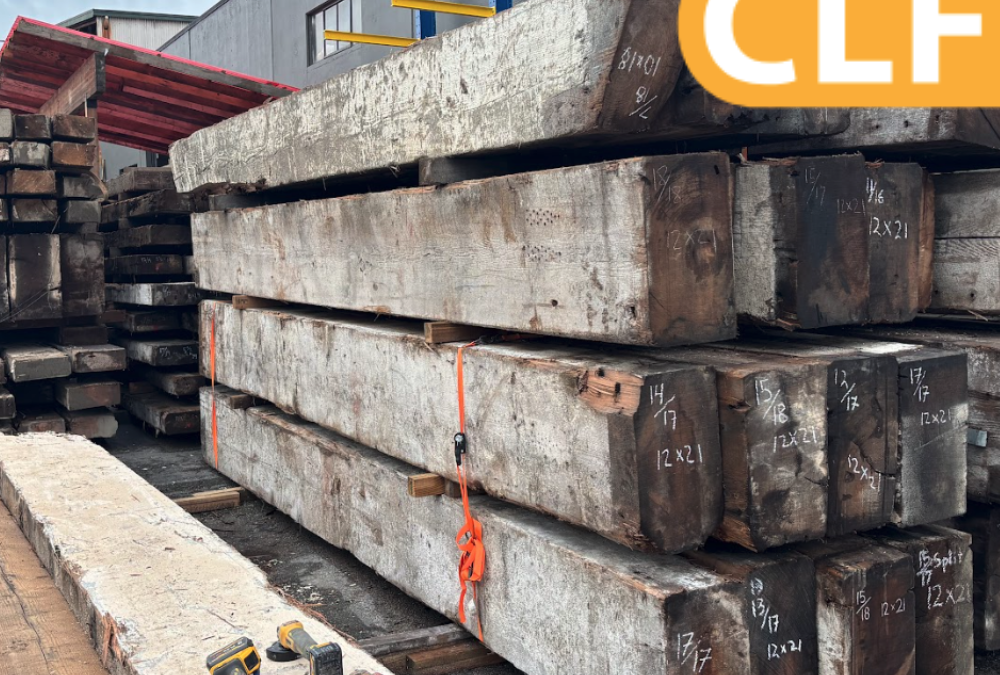
For framing lumber, the models track the diesel consumption of mobile deconstruction equipment, transport distances to salvage yards, and the electricity required for metal detection, denailing, and re-trimming. For structural steel, the accounting accounts for torch cutting, transit, non-destructive weld testing, dimensioning, and structural recertification. For clay masonry, the boundaries isolate the energy used for careful brick taking, mortar chipping, palletizing, and transport.
The pilot results confirm that even after accounting for the transport and mechanical energy required to reclaim and test these materials, their cradle-to-gate global warming potential remains far below that of newly extracted and manufactured equivalents. More importantly, the guidance provides the mathematical backing necessary for independent verifiers to certify those results without relying on ad hoc assumptions.
Next Steps for Operators, Vendors, and Policymakers
Publishing the modeling rules is only the first step toward commercial availability. For the guidance to change market reality, general program operators such as UL Solutions, ASTM, and SCS Global Services must adopt the proposed language into their overarching Part A and Part B PCRs. Doing so will enable third-party verifiers to accept applications from circular vendors.
At the same time, operators in the salvage and deconstruction sector, including regional salvage hubs and members of trade groups like Build Reuse, must begin gathering operational data. Establishing baseline utility data for deconstruction equipment, facility power, and yard logistics is necessary to generate verified EPD background reports. Finally, sustainability directors and municipal authorities updating local codes can begin establishing compliance pathways that recognize reuse declarations, ensuring that circular materials gain equal footing in institutional procurement.
What Professionals Should Know
- Program operators like UL Solutions, ASTM, and SCS Global Services must incorporate modular reuse pathways into existing Part A and Part B rules.
- Life cycle assessment practitioners should adopt the burden-free cut-off at salvage, reallocating modules A1 through A3 to deconstruction, transport, and refurbishment.
- Salvage operators and circular businesses must begin tracking energy, transport, and testing data to build background datasets for future EPDs.
- Policymakers updating Buy Clean rules can now integrate verification mechanisms so reclaimed materials are not excluded in favor of new products.
Sources
- Reclaimed and Reused: Recommended LCA Modeling Guidance to Support EPDs for Reused Construction Materials — Carbon Leadership Forum (University of Washington College of Built Environments)
- April 2026 Newsletter: Help Scale Up Material Reuse! Advance the EPD Ecosystem for Reused Construction Products — Carbon Leadership Forum
- CLF Featured Research Archives — Carbon Leadership Forum
- Embodied Carbon Life Cycle Assessment Reference Guide — City of Boston Planning Department in collaboration with CLF