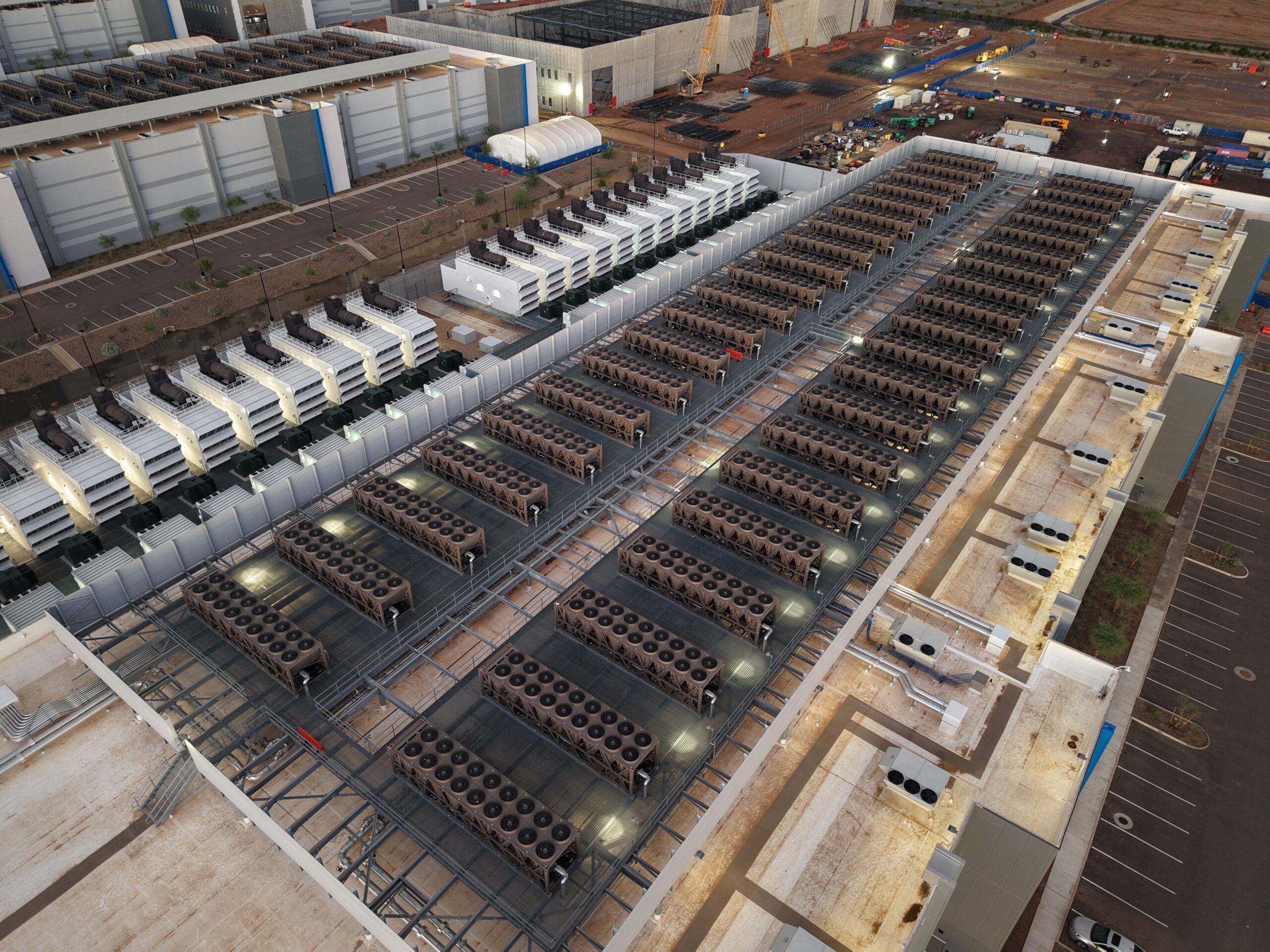
Why it matters: Data center electricity demand is projected to reach 12 percent of total domestic consumption by 2028. Unifying mechanical cooling and electrical hardware standards allows engineers, architects, and operators to safely transition from air cooling to liquid systems, mitigate equipment failures, and ease interconnection bottlenecks on strained regional power grids.
A sharp increase in computation density is forcing a structural rethink of mission-critical facilities. On June 10, 2026, ASHRAE, the National Electrical Manufacturers Association, and the Department of Energy Pacific Northwest National Laboratory jointly published the AI Data Center Energy Performance Framework. Developed over a 12-month period with more than 50 industry partners including NVIDIA, IBM, Carrier, and Siemens, the living digital guide directly addresses the operational strain that dense computing clusters place on building envelopes, mechanical systems, and regional electrical utilities.
Bridging Mechanical and Electrical Infrastructure
Data center planning has historically separated thermal management from upstream electrical delivery. Mechanical engineers designed around building cooling loads governed by ASHRAE Standard 90.4 and thermal envelope guidance from ASHRAE Technical Committee 9.9. Electrical teams separately specified switchgear, transformers, and distribution topologies. The new framework synthesizes these workflows, integrating TC 9.9 thermal loop criteria with more than a dozen NEMA electrical standards.
The integration reflects physical realities on the data hall floor. Electrical hardware represents 30 percent to 40 percent of typical facility capital equipment, and modern computing hardware generates power densities ranging from 40 kW to more than 100 kW per rack. Air-based cooling and conventional raised-floor containment struggle to reject heat at these concentrations. By aligning electrical equipment specifications with advanced cooling architectures, the framework establishes coordinated criteria for direct-to-chip liquid loops, full immersion systems, and the medium-voltage equipment feeding them.
Managing Regional Grid Constraints
The urgency behind the framework stems from escalating resource consumption. Domestic data centers absorbed roughly 4.4 percent of total United States electricity demand in 2023, with projections indicating that share could reach approximately 12 percent by 2028. Between 2019 and 2023, data center installations alone accounted for a 10 percent electricity demand jump across the ten fastest-expanding states. With more than 3,000 facilities operating nationwide and another 1,500 under planning or active construction, developers face multi-year waits for utility interconnects.
NEMA Chief Executive Officer Debra Phillips and ASHRAE President Bill McQuade stated that applying the unified framework will optimize thermal efficiency, eliminate avoidable power outages, and minimize operational disruptions across mission-critical sites. Rather than treating facilities as passive base loads, the guidance outlines methods for dynamic grid coordination. Facility operators are directed toward automated demand-response capabilities, microgrid synchronization, battery energy storage systems for peak shaving, and active load throttling where computing jobs modulate based on thermal conditions and local utility stress.
Lifecycle Coordination From Siting to Operation
Organized across comprehensive project lifecycle phases, the framework spans preliminary siting, architectural planning, MEP engineering, commissioning, retrofits, and daily facility management. Bing Liu, who leads building and industrial programs at PNNL, directed the working group to ensure that pre-concept planning incorporates hyper-local environmental factors. Designers are advised to evaluate site wet-bulb and dry-bulb conditions alongside behind-the-meter generation availability before finalizing building footprints or heat rejection schemes.
The guidance also addresses the physical realities of existing infrastructure. Because computing hardware cycles every 18 to 24 months while underlying building structures remain in service for decades, retrofitting air-cooled halls for high-density liquid loops presents structural, hydraulic, and electrical challenges. The framework provides specific retrofit pathways, detailing weight allowances for fluid distribution, medium-voltage transformer efficiency curves, direct-current distribution safety, and arc-flash mitigation.
Hosted natively on ASHRAE technical resource portal, the guide is structured as a living document to track fast-moving technological shifts. ASHRAE will host the 2027 Data Center and AI Integration Conference on March 3 through March 5, 2027, in Dallas, Texas, to examine real-world implementation data and update benchmarks across engineering disciplines.
What Professionals Should Know
- ASHRAE, NEMA, and PNNL have jointly launched a living engineering framework to standardize high-density data center design and operation.
- The guide merges ASHRAE TC 9.9 thermal loops and Standard 90.4 with over a dozen NEMA electrical standards to address 40 kW to 100+ kW rack densities.
- Design teams must implement grid-interactive capabilities, such as battery storage and automated demand response, to overcome multi-year utility interconnection delays.
- The living framework outlines specific retrofit pathways to adapt existing air-cooled mission-critical facilities for liquid and immersion cooling architectures.
Sources
- ASHRAE, NEMA, and PNNL Release AI Data Center Energy Performance Framework to Guide Next-Generation Design and Operation
- Business Wire Release on AI Data Center Energy Performance Framework
- AI Data Center Energy Performance Framework — ASHRAE
- Data Center Resources — ASHRAE
- Integrated Design Principles — ASHRAE
- Everything You Need to Know About Building Data Centers in One Place — Pacific Northwest National Laboratory
- Building More Efficient and Resilient AI Data Centers — Pacific Northwest National Laboratory
- Powering Data Centers — National Electrical Manufacturers Association (NEMA)
- Power Surge: AI Data Centres — Highways Today
- New ASHRAE Framework Targets AI Data Center Energy Challenges — FacilitiesNet
- ASHRAE Ireland News — ASHRAE Ireland Chapter